Research records
NIR
Every paper the faculty’s researchers publish, entered once and filed properly.

The situation
Researchers at Serbian faculties are evaluated partly on what they publish. The Ministry sorts publications into categories, from M21 for a paper in a top international journal to M33 for a full paper in international conference proceedings, and those categories count when someone is up for promotion and when the faculty is accredited.
Before NIR, that information was scattered across people’s own lists and files, and checking papers for the Ministry was done by hand.
M21, M33… The Ministry’s codes for types of publication. Each category is worth a set number of points in evaluations, so getting the category right matters.
What I built
NIR gives every researcher a record card with their papers on it. Each paper is entered once, with its category, year, publisher, DOI and, where possible, the PDF.
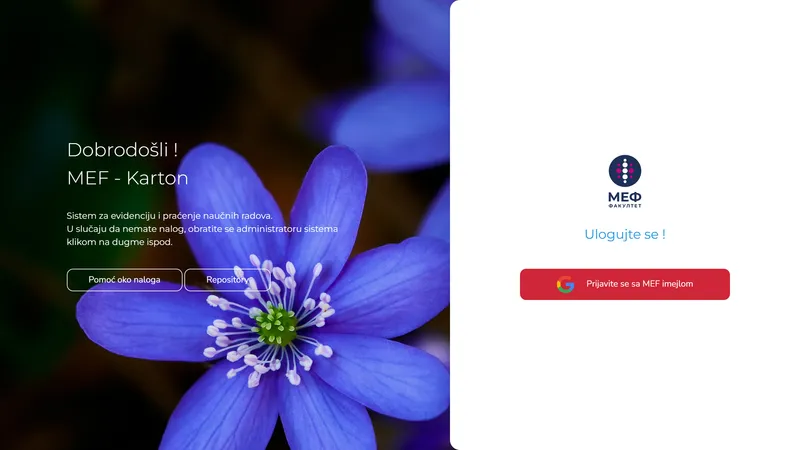
People sign in with their MEF Google account. Accounts are opened by the administrator, so only faculty staff can add records.
Everything that should be public appears in the faculty’s online repository. Anyone can search it by title, author, DOI or ISBN, filter it by type of publication, year, author and whether the full text is attached, open a researcher’s page and download the attached PDFs.
A look inside
Screens from the part of NIR that only faculty staff see. The interface is in Serbian.
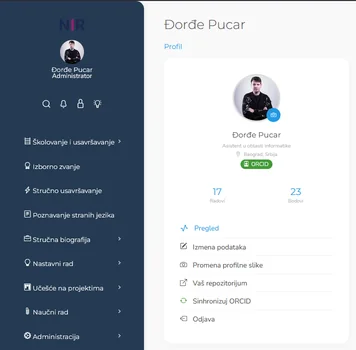
The researcher’s card
Papers are one section of the card. Education, academic title, professional training, languages, a professional biography, teaching and projects each have their own. The overview shows how many papers someone has and how many points they’re worth.
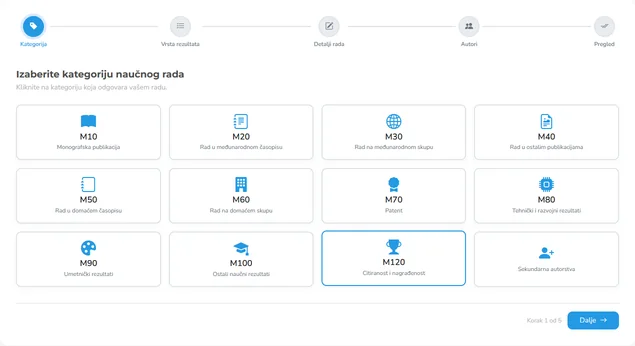
Adding a paper
Five short steps: the category, the exact type of result, the paper’s details, the authors, and a final check. It starts with the Ministry’s categories, M10 to M120.
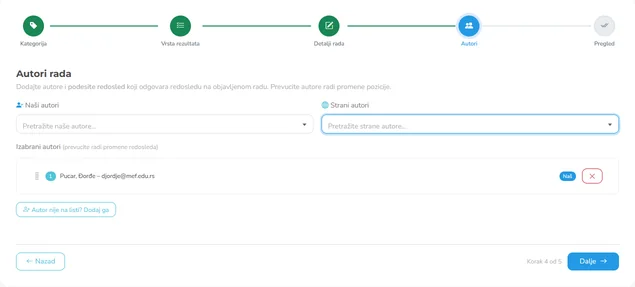
Authors, in order
Co-authors are picked from two lists, the faculty’s own researchers and outside authors, and dragged into the order they appear on the paper. Anyone missing can be added on the spot.
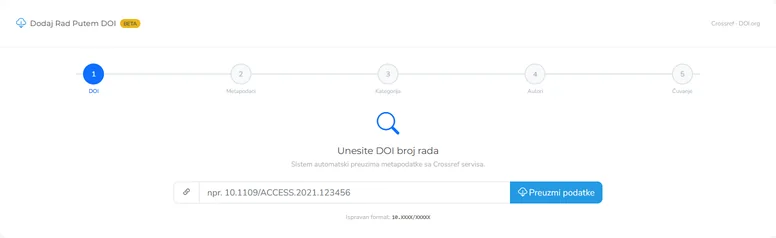
Or start from a DOI
For a paper with a DOI there’s a shortcut: NIR fetches its details from Crossref, and the researcher checks them, picks the category and confirms the authors. This one is still in beta.
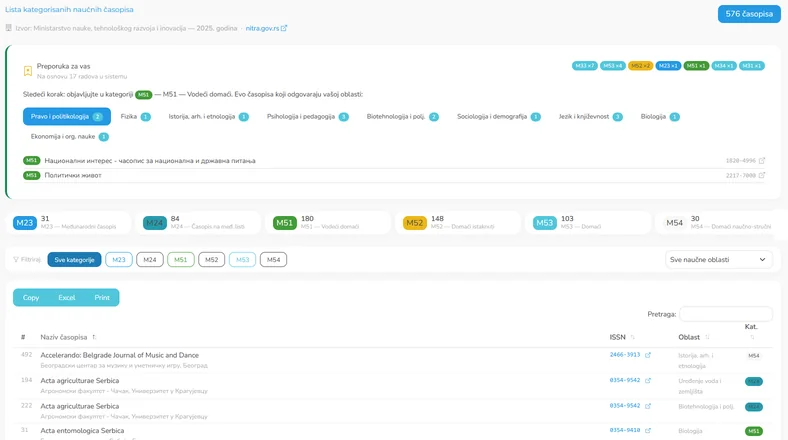
Where to publish next
NIR includes the Ministry’s 2025 list of categorized journals, 576 of them, with filters by category and field. Based on the papers a researcher already has, it suggests which category to aim for next and lists journals that fit.
How it works
Every paper becomes one record. The same record then shows up in three places, so nobody types it twice.
OAI-PMH A long-established standard that lets other systems collect a repository’s records automatically. NIR publishes them in Dublin Core, the format those systems expect.
A paper’s record
- Title
- as published
- Authors
- linked to their pages
- Year
- of publication
- Category
- the Ministry’s code, e.g. M33
- Publisher
- journal or conference
- DOI
- permanent link to the paper
- attached when allowed
- The researcher’s pageAll their papers in one list.
- The public repositorySearchable, with filters for type, year and author.
- Other systemsCollected automatically through OAI-PMH, including the Ministry’s.
Diagram
- papers
- 1,974
- authors
- 43
- oldest paper
- 1997
- with the PDF attached
- 616
The public repository, counted in October 2026.
My part
I designed NIR and built all of it, from the database to the screens, and I still administer it. It’s also a project with a history for me: my bachelor’s thesis in 2020 was about building this kind of record card in CodeIgniter 3.
The result
The faculty has one public list of its research instead of many private ones. In October 2026 the repository held 1,974 papers by 43 authors, going back to 1997, and 616 of them had the full PDF attached.
Researchers keep their own records up to date, and the same data serves the repository and the reports, so it doesn’t have to be collected from scratch each time.
Technical details
For developers: the stack and how the pieces fit together.
- Framework
- CodeIgniter 4 (PHP)
- Database
- MySQL
- Sign-in
- Google sign-in for MEF accounts; accounts opened by an administrator
- Access
- Role-based permissions
- Repository
- Public pages with search (title, author, DOI, ISBN), filters (type, year, full text, author) and a page per author
- Records
- Each paper has a permanent handle; PDFs are served through download links
- Paper import
- DOI lookup through the Crossref API (in beta)
- Journals
- The Ministry’s 2025 list of categorized journals, with filters, search and Excel export
- ORCID
- Each profile carries the researcher’s ORCID iD and can sync with ORCID
- Interoperability
- OAI-PMH 2.0 endpoint, records in Dublin Core (oai_dc)